
Free Coloring Resources: Interactive Tools & Step-by-Step Tutorials
Home » Blog » Free Coloring Resources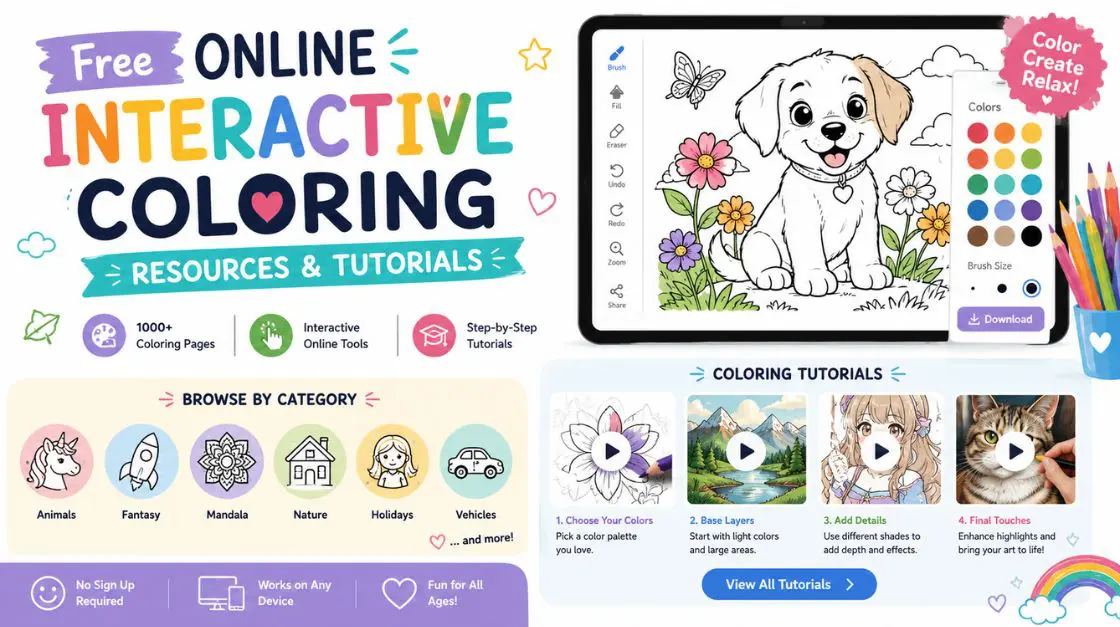
The best free coloring resources aren’t printable pages — they’re the skills and knowledge that make every page you color look better. This hub collects the interactive tools, technique tutorials, color theory guides, and creative exercises available on this site at no cost. Everything here works in your browser on any device, with no download or purchase required.
These free coloring resources and tutorials are built for colorists at every level: complete beginners who want to understand color before picking up a pencil, intermediate artists who want to push their blending further, and experienced colorists who want a creative reset or fresh palette inspiration. Each tool or tutorial stands alone, so you can start anywhere and revisit as often as you like.
This page is updated as new free creative resources for coloring are added to the site. Use the section headings below to jump directly to what you need, or read through to discover tools you didn’t know existed.
Quick Answer
What Free Coloring Resources Are Available Here?
What are free coloring resources? Free coloring resources are no-cost interactive tools and tutorials that help colorists build technique, understand color theory, and develop a more intentional creative practice. Unlike printable coloring pages, these resources focus on the process of coloring — how to select palettes, blend colors, apply shading, and make artistic decisions with confidence.
The free coloring resources on this page include:
- An interactive color palette generator that builds harmonious combinations from any starting color
- A color personality quiz that matches your creative style to a coloring approach
- A color theory tutorial covering the color wheel, harmony types, hue, saturation, and value
- A coloring techniques tutorial library with walkthroughs for blending, shading, and layering
- A coloring tools hub that links every free interactive resource on the site in one place
- In-depth technique guides covering specific skills: mandala coloring, color blending, beginner techniques, and more
All free creative resources for coloring on this page are browser-based and work on desktop and mobile.
browse by category
Free interactive tutorials
Learn blending, shading, and color theory with step-by-step guides.
Free interactive tools
Use palette generators, quizzes, and interactive tools to boost creativity.
Free coloring Pages
Download, print, and color beautiful designs made for every age and skill level.
Free Interactive coloring tools
These free coloring resources are interactive — you use them actively in your browser rather than reading passively. Each one produces something you can apply immediately to whatever you’re coloring.
Color Palette Generator
Try the Color Palette Generator →
Choosing colors is one of the hardest parts of coloring, and one of the most consequential. This free tool removes the guesswork entirely. Enter any starting color and the generator builds a full palette around it using established color harmony rules: complementary, analogous, split-complementary, triadic, and tetradic combinations.
The results are instant and adjustable. Shift the base color, swap the harmony type, and watch the palette update in real time. Use it before you start a page, mid-session when a color combination isn’t landing, or as a pure exploration tool to discover new pairings you wouldn’t have reached intuitively.
- Who it’s for: Any colorist who wants cohesive, intentional color choices without studying color theory first
- How to use it: Pick a color you already know you want to use, select a harmony type, and let the generator fill the rest of your palette
- Best paired with: The color theory tutorial below, which explains why each harmony type works the way it does
Color Personality Quiz
Take the Color Personality Quiz →
This is one of the most popular free creative resources for coloring on the site — and the most personal. In about five minutes, a series of questions about how you make decisions, what environments calm you, and what draws your eye in art produces a detailed creative color profile.
The profile tells you which palette temperatures you’re naturally drawn to (warm, cool, or balanced), which coloring styles tend to suit your personality (detailed and structured, loose and expressive, or pattern-based), and which subject categories — botanical, geometric, fantasy, scenic — align with your instincts. It’s a surprisingly effective starting point for colorists who feel overwhelmed by choice.
- Who it’s for: Beginners unsure where to start; experienced colorists who want to understand their preferences better
- How to use it: Answer honestly rather than aspirationally — the most useful results come from describing how you actually think, not how you’d like to
- What you get: A named color profile with palette suggestions, style guidance, and recommended coloring categories
Free Coloring Tools Hub
Browse All Free Coloring Tools →
This hub page collects фдд interactive free coloring resource on the site in one navigable space. It’s the fastest way to survey what’s available and pick what fits your current session or creative goal. The tools are grouped by function — palette-building, style discovery, technique support — so you can find what you need without scrolling through unrelated content.
- Who it’s for: Anyone who wants a complete picture of free creative resources for coloring in one place
- How to use it: Browse the categories, try anything that sounds relevant, save the URL for future visits
Free Coloring Tutorials
Where the tools above are interactive and produce immediate outputs, these free coloring resources and tutorials build knowledge and techniques that stay with you across every future coloring session.
Color Theory Tutorial for Colorists
Work Through the Color Theory Tutorial →
This is the most comprehensive single free coloring resource on the site for understanding why color choices work. The tutorial walks through the full color wheel, explains primary, secondary, and tertiary relationships, introduces warm and cool tone dynamics, and shows how hue, saturation, and value each affect the feeling of a finished page.
Every section connects theory directly to coloring practice. This isn’t abstract art school material — it’s color theory explained in terms of what you’ll actually encounter when you sit down with a coloring page and a set of pencils or markers.
Working through this tutorial alongside the palette generator creates a powerful combination: the generator gives you ready-made palettes instantly, and the tutorial helps you understand the logic behind them so you can start building your own.
- Who it’s for: Beginners who want a solid foundation; any colorist whose color choices feel hit-or-miss
- Time investment: Can be read in 20–30 minutes; works well revisited in sections over time
- Key concepts covered: Color wheel, complementary and analogous colors, warm vs. cool contrast, value and saturation, applying theory to coloring pages
Coloring Techniques for Beginners
Read the Beginner Techniques Guide →
One of the most frequently visited free coloring resources and tutorials on the site, this guide covers the foundational physical techniques that determine how a colored page looks and feels. It explains how to hold pencils or markers for different effects, how to build color gradually through layering, how to avoid common mistakes like heavy-handed application or patchy coverage, and how to approach a new page strategically rather than just starting in the top-left corner.
The guide is written without assuming any prior experience. If you’ve just started coloring and your pages aren’t looking the way you imagined, this tutorial addresses the most common reasons why.
- Who it’s for: Anyone in their first weeks or months of coloring; colorists who feel stuck at a plateau
- Skills covered: Pencil pressure, layering, stroke direction, color application sequence, avoiding patchiness
Color Blending Techniques
Explore the Blending Techniques Guide →
Smooth blending is the technique colorists most often want to improve, and one of the most rewarding free creative resources for coloring on the site is dedicated entirely to it. This step-by-step guide covers the mechanics of blending with colored pencils, the difference between burnishing and layering blends, how to create smooth gradients between colors, and how to fix harsh or uneven blends.
Separate sections address blending specifically for different color transitions — analogous colors (easy, forgiving), complementary colors (requires care), and light-to-dark gradients (the most common use case in coloring). Practical examples illustrate each technique applied to specific areas of coloring pages.
- Who it’s for: Colorists who’ve moved past the pure beginner stage and want smoother, more polished results
- Skills covered: Layered blending, burnishing, gradient construction, complementary color transitions, fixing problem blends
Mandala Coloring Techniques for Beginners
Read the Mandala Technique Guide →
Mandalas have their own logic. The symmetry that makes them satisfying to look at also creates specific challenges when coloring: maintaining consistency across repeated sections, choosing whether to follow or break the symmetry with color, and deciding how to handle the dense central detail versus the open outer areas.
This tutorial addresses all of those decisions with a clear, beginner-friendly approach. It recommends a working sequence (outside-in vs. inside-out), explains how to mark your color choices before committing, and shows how to use value contrast to make complex mandala structures read clearly rather than turning into visual noise.
- Who it’s for: Anyone coloring mandalas for the first time; colorists who find mandala results inconsistent
- Skills covered: Symmetrical color planning, section-by-section working method, value contrast in geometric patterns, common mandala coloring mistakes
Color Theory Basics
A shorter, more focused companion to the full color theory tutorial above, this guide distills the essential principles into a quick-reference format. The color wheel, the three primary harmony types, and the relationship between warm and cool tones are covered clearly enough to be useful in the middle of a coloring session when you need a fast answer.
Among the free coloring resources and tutorials on the site, this one works best as an entry point before the full tutorial or as a refresher to check your understanding of a specific concept.
- Who it’s for: Colorists who want a faster overview before diving deeper; quick reference during an active session
- Key concepts: Color wheel basics, primary/secondary/tertiary colors, warm vs. cool, basic harmony types
Interactive Coloring Tutorials for Adults
Explore the Full Tutorial Collection →
This page collects technique-focused tutorials oriented specifically toward adult colorists — covering both fundamental skills and more advanced approaches for those who’ve been coloring for a while. It includes guidance on coloring techniques for specific subject types (florals, mandalas, scenes, fashion illustrations), tips for matching your tool choice to different design styles, and worked examples across skill levels.
The collection expands as new free coloring resources and tutorials are added to the site, making it worth returning to periodically, even if you’ve visited before.
- Who it’s for: Adult colorists across all skill levels who want technique guidance tailored to the kind of pages they actually color
- Topics covered: Subject-specific techniques, tool-to-style matching, advanced layering approaches, and how to approach complex designs
What You Can Learn With These Free Resources
Used together, these free coloring resources and tutorials cover the full learning path from first-time colorist to confident, intentional artist:
Foundation layer (start here): Color Theory Basics → Color Theory Tutorial → Coloring Techniques for Beginners
Skill-building layer (once you’ve practiced the basics): Color Blending Techniques → Mandala Coloring Techniques → Interactive Tutorials for Adults
Ongoing support (return to these any time): Color Palette Generator → Color Personality Quiz → Free Coloring Tools Hub
This progression is a recommendation, not a requirement. Most free creative resources for coloring work as standalone resources — you don’t need to have completed earlier steps to benefit from any individual tutorial or tool.
Free Tools vs. Premium PDF Collections: Knowing When to Upgrade
The free coloring resources here are complete and genuinely useful on their own. They aren’t previews or lead-ins to a paid course. That said, there’s a natural point at which the tools and tutorials have done their job, and what you need next is more pages to practice on.
| Free Resources (This Page) | Premium PDF Collections | |
|---|---|---|
| What’s included | Interactive tools, technique tutorials, and color guides | Curated print-ready coloring page sets |
| Format | Browser-based, no download | Instant-download PDF, 300 DPI |
| Best for | Building skills, discovering your style, and palette planning | Sustained practice, gifts, and classroom use |
| Volume | Unlimited tool use | 9 to 400+ pages per collection |
| Cost | Free | Paid |
| When it fits | Always — especially when learning | When you want a reliable stack of pages to color |
The honest answer: If you’re new to coloring, spend time with the free creative resources for coloring first. Build your color vocabulary, get comfortable with technique, and figure out what subject styles you enjoy. When the free tools feel familiar, and you find yourself wanting more pages faster than you can find good ones, that’s the right moment to explore the premium collections.
Browse the full premium collection →
Try the 9-page sampler first →
Who These Resources Work Best For
Beginners
Start with the Color Personality Quiz to discover your style, then work through Color Theory Basics and the Beginner Techniques Guide before picking up a pencil. These three free coloring resources give you a working framework before your first page.
Intermediate Colorists
The Color Blending Techniques guide and the full Color Theory Tutorial are where intermediate colorists typically find the most value. Both address the gap between “technically correct” coloring and results that feel polished and intentional.
Teachers & Classroom Use
The color theory tutorial and beginner technique guides work well as structured lesson frameworks. The Art Therapy for Stress article provides research-backed context for using coloring as a classroom wellness activity. For premium classroom-ready resources, see Classroom Coloring Pages and Calm Corner Coloring Pages.
Wellness & Mindfulness Practice
Pair the Color Palette Generator with the Coloring and Mindfulness guide to build a more intentional coloring practice. Choosing a calming palette before you start — rather than reaching for whatever’s nearest — makes a measurable difference to the meditative quality of a session. The Art Therapy for Stress article explains the neuroscience behind why.
Experienced Colorists
The Interactive Coloring Tutorials for Adults and the Color Palette Generator are the two most useful free coloring resources and tutorials at this level. Experienced colorists often benefit from deliberate palette constraints — using the generator to set a fixed palette before starting, for example, produces noticeably more cohesive finished pages.
How to Make the Most of These Tools: A Practical Guide
Step 1: Identify your starting point. If you don’t have a clear coloring style or color preference yet, begin with the Color Personality Quiz. It takes five minutes and gives you a useful orientation.
Step 2: Build your color knowledge. Work through Color Theory Basics first for a quick grounding, then the full Color Theory Tutorial when you have more time. These free coloring resources and tutorials pay dividends across every coloring session after you complete them.
Step 3: Choose a palette before you start. Use the Color Palette Generator to build a palette for your next page. Commit to it before you start. Colorists who plan palettes in advance consistently produce more cohesive results than those who choose colors as they go.
Step 4: Apply the right technique. Match the technique tutorial to the design type. Mandalas → Mandala Coloring Techniques. Florals, scenes, or any detailed design → Color Blending Techniques. First time coloring anything → Techniques for Beginners.
Step 5: Return and explore. The Free Coloring Tools Hub is updated as new free creative coloring resources are added. Checking back periodically is the easiest way to stay current with new tools and tutorials without having to search for them.
Frequently Asked Questions
Q1: What free coloring resources are available without signing up?
A: The color palette generator, color personality quiz, color theory tutorial, color theory basics guide, coloring techniques for beginners, color blending techniques guide, mandala coloring techniques guide, and the full interactive tutorials collection are all freely accessible without registration or purchase.
Q2: Are these tutorials suitable for complete beginners?
A: Yes. The free coloring resources and tutorials on this site are sequenced to work from the ground up. The Color Theory Basics guide and Coloring Techniques for Beginners tutorial assume no prior knowledge and build from first principles.
Q3: Do I need any special software or apps to use the interactive tools?A: No. All free creative resources for coloring on this site run in a standard web browser. No app download, plugin, or account is required. They work on desktops, tablets, and mobiles.
Q4: How is the color palette generator different from a standard color picker?
A: A standard color picker lets you select any color. The palette generator uses color harmony rules — complementary, analogous, triadic, and others — to build a complete, balanced palette around a starting color. The result is a set of colors that work together, not just individual picks.
Q5: Can I use these tutorials with any coloring medium?
A: The core concepts — color theory, palette selection, blending logic — apply across all dry media, including colored pencils, fine-liners, and gel pens. The blending techniques guide focuses primarily on colored pencils, but notes where techniques differ for markers or other tools.
Q6: How often are new free coloring resources and tutorials added?
A: New free creative resources for coloring are added on an ongoing basis. The tools hub page is kept up to date as new resources go live. The most reliable way to stay informed is to check the Free Coloring Tools Hub directly.
Q7: Are these free resources genuinely free, or is there a catch?
A: These are genuinely free coloring resources — no paywall, no trial period, no upsell required to access the tools or tutorials. The premium PDF collections are a separate, paid part of the site that’s clearly labeled as such.
Q8: What’s the best single free resource to start with if I have limited time?
A: The Color Palette Generator gives you an immediately usable output in under two minutes. If you have ten to fifteen minutes, start with the Color Personality Quiz followed by the generator — the combination of knowing your style and having a ready palette makes for a noticeably better first session.
Q9: Are there free coloring resources specifically for stress relief and mindfulness?
A: Yes. The Coloring and Mindfulness guide and the Art Therapy for Stress article are both free and explain both the practice and the research behind using coloring for mental well-being. The palette generator is also useful in this context — selecting a deliberately calm, cool palette before a mindfulness session adds an intentional dimension to the practice.
Q10: Where can I find premium coloring pages to practice these techniques on?
A: The full collection of premium printable coloring pages is organized by theme, difficulty, and subject. If you want to try before purchasing, the 9-page sampler covers multiple styles at a low entry price.
Q11: Is there a recommended sequence for working through the tutorials?
A: For most colorists: Color Theory Basics → Color Theory Tutorial → Coloring Techniques for Beginners → Color Blending Techniques → subject-specific tutorials as needed. The free coloring resources and tutorials are designed to build on each other in that order, though each works as a standalone resource if you have a specific skill you want to address.
Q12: Can teachers use these tutorials as classroom resources?
A: Yes. The color theory tutorial and technique guides have no licensing restrictions on classroom use. They can be used as lesson frameworks, projected in class, or shared as reading assignments for older students. For classroom-specific coloring page sets, see the Classroom Coloring Pages premium collection.