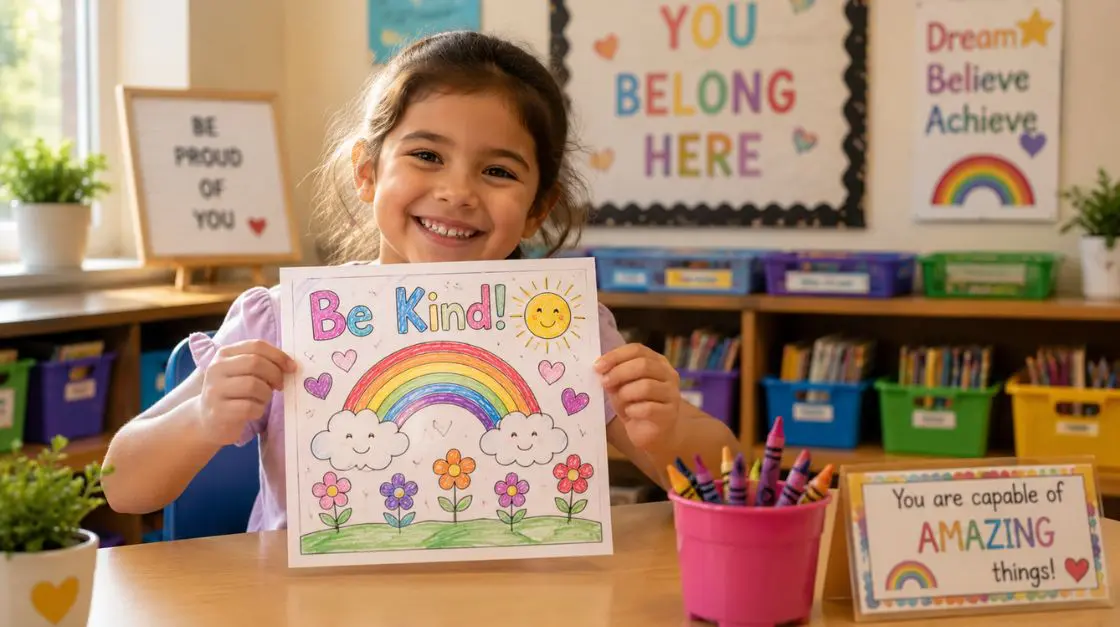
Printable Coloring Pages for Classroom: How They Can Transform Learning
Every teacher has experienced that moment: you need five more minutes to finish a lesson transition, some students have already completed their work, and the classroom is getting louder. Printable Coloring Pages for Classroom activities can solve that challenge while reinforcing learning.
More than just a fun activity, Printable Coloring Pages for Classroom use can build vocabulary, strengthen fine motor skills, reinforce science and math concepts, encourage creativity, and help students develop focus and self-regulation—all with a simple printed worksheet.
Their greatest strength is their simplicity. They’re easy to prepare, adaptable for different age groups, and flexible enough to support almost any subject or learning objective.
In this complete guide, you’ll discover everything you need to make Printable Coloring Pages for Classroom instruction an essential part of your teaching toolkit. We’ll explore the educational benefits, classroom strategies, activity ideas, printable resources, and practical, step-by-step tips to transform ordinary coloring pages into meaningful learning experiences.
Ready to upgrade your classroom activities?
Browse printable classroom resources →
Quick Answer
Coloring pages are versatile classroom resources that support literacy, fine motor development, emotional regulation, and content learning across K–2 settings. Teachers use them as morning work, early finisher activities, literacy center rotations, and calm-down tools. They require zero prep, are low-cost, and work for all learners, including ELLs and special education students.
Why Coloring Pages Belong in Every Classroom Resource Collection
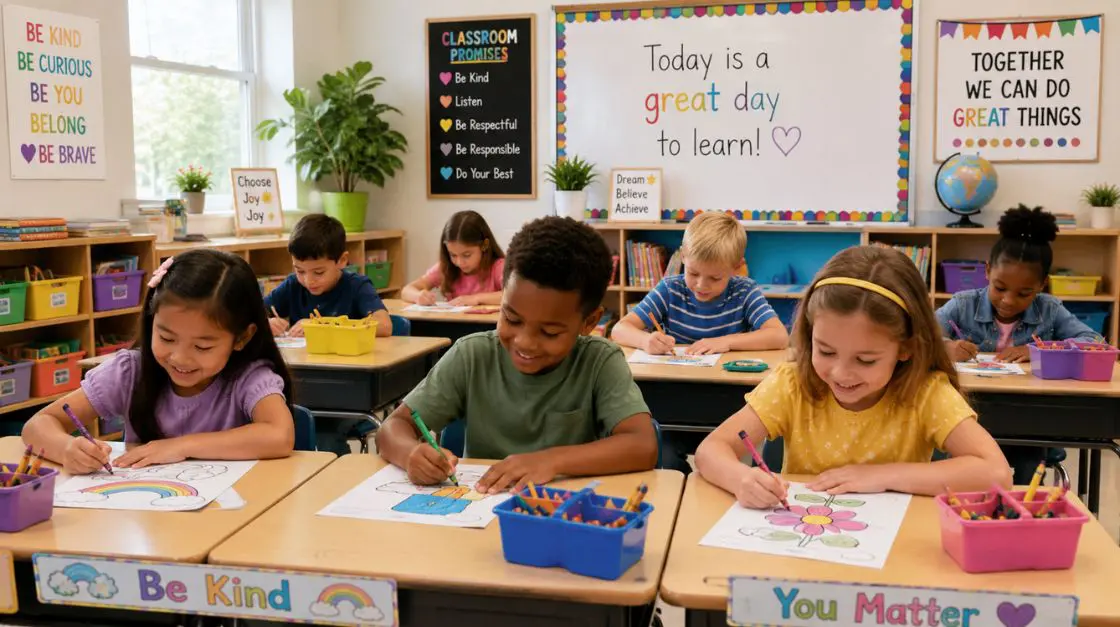
Teachers at every level — kindergarten, first grade, second grade, and beyond — are under constant pressure to maximize instructional time while still meeting students where they are. Classroom resources that can serve multiple purposes without requiring hours of prep are rare. Coloring pages are one of those rare finds.
They Do More Than Fill Time
When a child picks up a crayon and begins to color, the brain does several things at once. It focuses. It slows down. It makes decisions about color, direction, and pressure. For young learners, that’s rich cognitive and sensory work dressed up as play.
Used intentionally, coloring pages become one of the most flexible classroom activities in your rotation:
- Morning work: Students settle in, transition smoothly, and start the day with a calm, purposeful task.
- Early finisher activities: High-achieving students have something meaningful while you finish whole-group instruction.
- Literacy centers: Theme-based coloring paired with vocabulary words, sight words, or read-alouds.
- Brain breaks: A five-minute coloring pause resets attention better than free choice for many learners.
- Homework alternative: A low-stakes, family-friendly activity that still builds skill.
They Work for Every Learner in the Room
One of the biggest challenges in inclusive classrooms is finding activities for teachers that meet the needs of every student simultaneously. Coloring pages do this naturally:
- ELL students engage meaningfully without language barriers.
- Special education and OT contexts use coloring for fine motor development and sensory regulation.
- Students who struggle with writing can demonstrate their understanding by coloring before transitioning to written work.
- Advanced learners can add labels, patterns, and details independently.
Homeschool parents love them for exactly the same reason: one printable, many applications, zero conflict about what to do next.
The Science Behind Why Coloring Works as a Classroom Resource
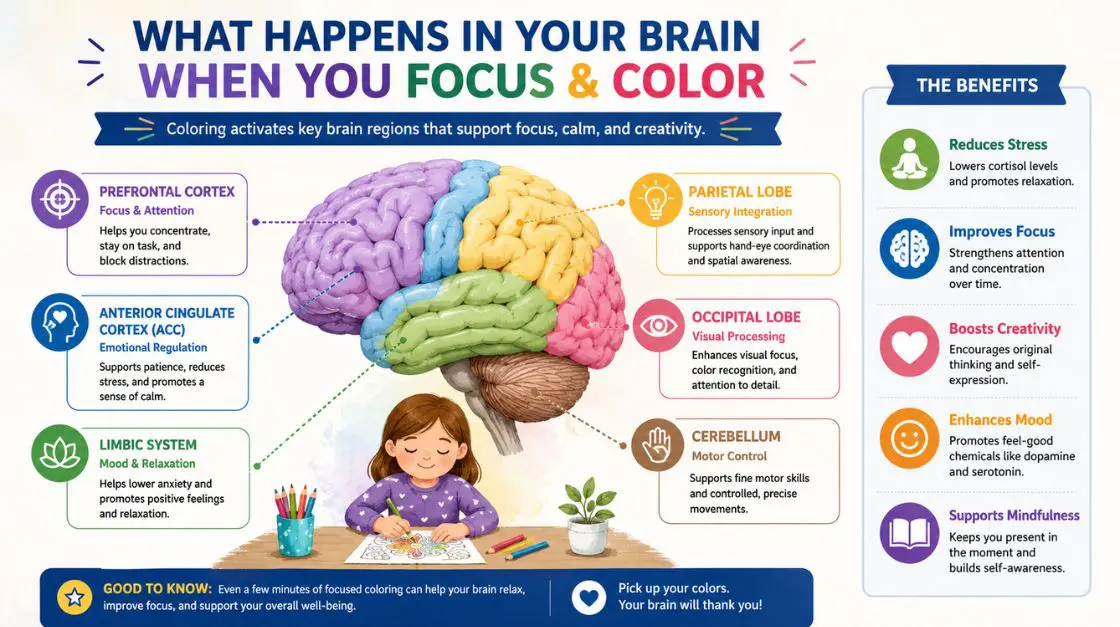
You don’t need to justify coloring to anyone who has watched a dysregulated child settle within two minutes of picking up a colored pencil. But the research is there if you need it.
Fine Motor Development
Occupational therapists have long used structured coloring activities to develop the precise hand movements children need for writing. Staying within lines, adjusting grip pressure, and controlling direction all strengthen the same muscle groups used in handwriting. This makes coloring worksheets for kindergarten a natural bridge between play-based learning and formal writing readiness.
Focused Attention and Self-Regulation
Coloring requires what researchers call “sustained selective attention” — the ability to stay with one task and tune out distractions. For young learners, especially those with attention challenges, this is a skill that has to be practiced. Structured classroom activities like themed coloring pages provide exactly that practice in a low-stress format.
School counselors and paraprofessionals frequently use calm-down coloring stations as part of emotional regulation plans. A child who is overwhelmed can color for a few minutes, reset, and return to the group — without disrupting anyone.
Content Retention Through Active Engagement
When students color a diagram of the water cycle, an illustration of a community helper, or a page labeled with seasonal vocabulary, they’re doing something more than coloring. They’re encoding information through motor memory, visual processing, and focused attention all at once. That multi-modal engagement supports retention far better than passive reading.
This is why themed classroom materials — animals, seasons, cultural topics, emotions — pair so naturally with direct instruction.
Creativity and Autonomy
There’s also the less-measured but deeply important benefit of creative expression. For children who spend most of their school day following prescribed steps, a coloring page offers a moment of genuine choice. Which color? What pattern? Do I want to add a background? That sense of ownership and self-direction builds intrinsic motivation over time.
Types of Coloring Pages That Work as Classroom Resources
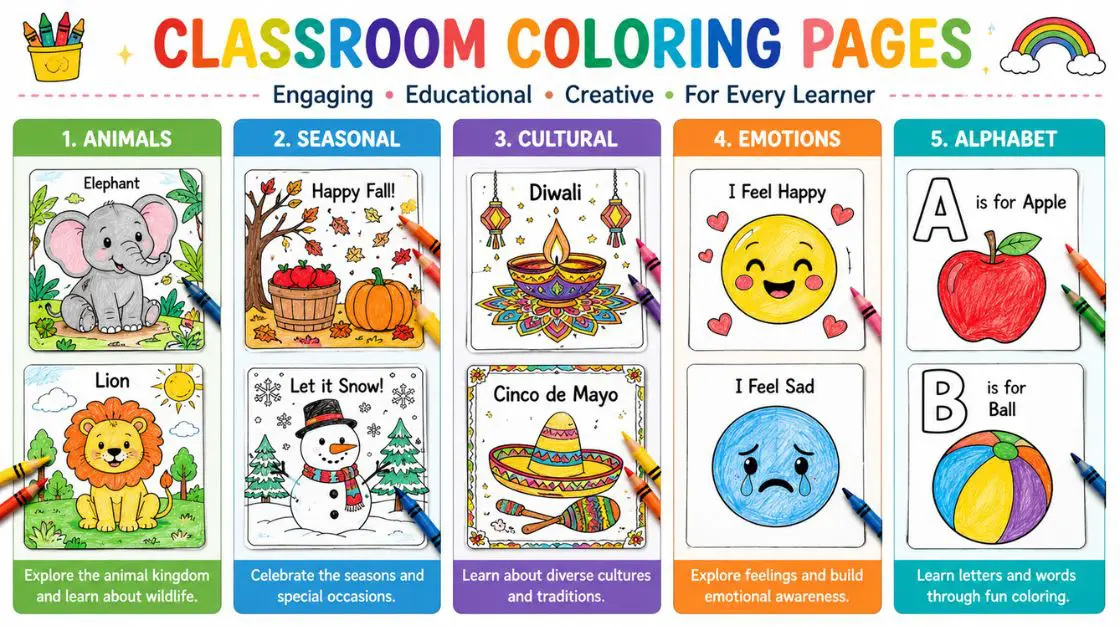
Not all coloring pages are built the same — and the best activities for teachers are the ones matched intentionally to the learning goal or moment in the day.
Seasonal and Holiday Coloring Pages
Seasonal themes are among the most versatile classroom activities. They connect to almost every content area — science (weather, plant cycles), social studies (community celebrations), and literacy (seasonal vocabulary).
Fall coloring pages, winter coloring pages, spring coloring pages, and summer coloring pages work across the whole year. Seasonal classroom resources are also popular with homeschool parents and after-school program leaders who want activities that feel current and up to date.
Best for: Morning work, seasonal bulletin boards, literacy center extensions, take-home activities.
Animal Coloring Pages
Animal coloring pages are endlessly useful classroom materials. Use them to introduce a science unit on habitats, reinforce vocabulary during a read-aloud, or provide early-finisher activities paired with fact sheets.
Printable animal coloring pages connect naturally to science standards across K–2. Ocean animals, jungle wildlife, and farm animals can each anchor a week of instruction.
Best for: Science units, vocabulary reinforcement, K–2 content integration.
Emotions and Mindfulness Coloring Pages
For school counselors, special education teachers, and paraprofessionals working on social-emotional skills, emotion coloring pages are practical classroom resources with immediate application. Students color scenes that depict feelings, which opens conversation and builds emotional vocabulary.
Paired with the coloring therapy benefits framework, these pages become part of a broader well-being strategy rather than just a quiet-time filler.
Best for: SEL instruction, calm-down corners, counseling sessions, and morning meeting extensions.
Cultural and World Coloring Pages
Multicultural and world cultures coloring pages support both cultural competence and social studies standards. World cultures coloring pages for kids introduce students to diverse traditions, foods, clothing, and landscapes in an accessible, visual way.
ESL teachers find these particularly effective because images communicate across language barriers, allowing ELL students to engage fully while still building vocabulary.
Best for: Social studies integration, ESL classrooms, multicultural education goals.
Alphabet and Tracing Pages
Early literacy and fine motor practice combine in alphabet-based classroom resources. Alphabet tracing worksheets and letter-themed coloring pages work well as literacy center rotations, morning work, or intervention practice.
Best for: Kindergarten, pre-K, early literacy centers, literacy intervention.
Fantasy and Creative Themes
Unicorns, dragons, fairies — fantasy coloring pages for kids tap into the imaginative world that motivates many young learners. These work particularly well as early finisher activities or incentive-based choices because students genuinely want to do them.
Best for: Early-finisher stations, reward-based choices, creative writing tie-ins.
Printable Coloring Pages vs. Traditional Coloring Books
| Feature | Printable Classroom Resources | Traditional Coloring Books |
|---|---|---|
| Cost | Low — print as needed, often free or low-cost PDF | Per-book cost, not scalable for a full class |
| Flexibility | Print any quantity, any time | Fixed number of pages |
| Customization | Choose themes to match the curriculum | Generic themes only |
| Curriculum alignment | Select pages that match your unit or standard | Rarely aligned to the current lesson |
| Accessibility | Print at any size; can enlarge for visual needs | Fixed size |
| Waste | Print only what you need | Unused pages go to waste |
| Reusability | Reprint the same page for multiple uses, laminatable | One-time use per student |
| Variety | Access hundreds of themes from one source | Limited to one book’s content |
| Setup time | Near zero — print and go | None, but less targeted |
| Best for | Classroom activities, centers, and differentiation | Take-home, independent use |
Step-by-Step: How to Implement Coloring Pages in Your Classroom
Step 1: Identify Your Purpose First
Before printing anything, ask: What is this page doing in my classroom? Common purposes include:
- Transitional activity (morning work, after lunch, before specials)
- Content reinforcement (matching the page to a current unit)
- Fine motor practice (for OT goals or writing readiness)
- Emotional regulation (calm-down corner tool)
- Early finisher extension
Knowing the purpose helps you choose the right type and complexity of page.
Step 2: Choose Pages That Match Your Students
A coloring page that is too complex frustrates a kindergartener. One that is too simple bores a second grader. Match complexity to your students’ current abilities:
- Pre-K / Kindergarten: Large, simple outlines with minimal detail — kindergarten coloring pages work perfectly here.
- First grade: Moderate detail with optional labeling.
- Second grade: More intricate designs, can add writing prompts alongside.
For special education or OT contexts, bold-line, high-contrast pages reduce visual confusion.
Step 3: Decide on Print Setup
Most classroom resources, like coloring pages, print best on standard 8.5×11 copy paper. A few tips:
- For markers or watercolor crayons, use slightly heavier paper (24 lb or higher) to reduce bleed-through.
- For laminated reusable pages, print on cardstock and laminate after. Students use dry-erase markers and wipe them clean.
- For fine motor work, enlarging the page to 120–130% gives students more space to work.
Check out how to print coloring pages at home for a full walkthrough of print settings — the same tips apply to school printers.
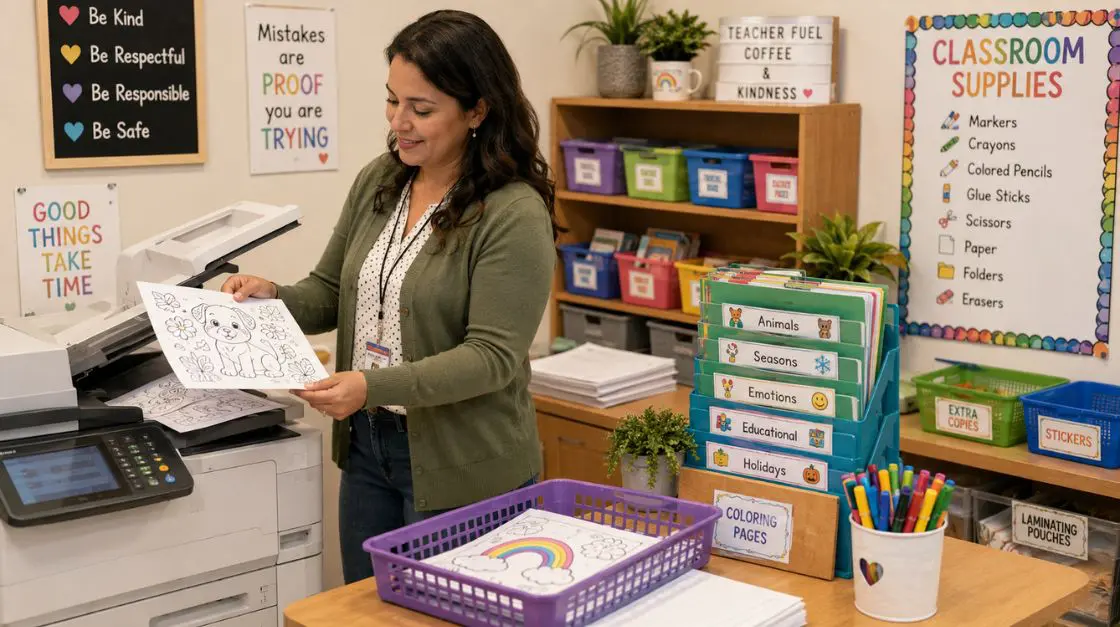
Step 4: Organize Your Classroom Materials
Classroom materials that aren’t organized don’t get used. Create a simple system:
- Theme binders: Store pages by season, subject, or unit in labeled binders.
- Quick-access folder: Keep a “current week” folder of 5–10 pages ready on your desk.
- Student choice bin: A small basket of varied pages students can choose from during free work time.
- Calm-down station: 2–3 pages (changed weekly) available in a designated quiet corner.
Step 5: Pair Coloring Pages with Learning Objectives
The difference between a coloring page as filler and a coloring page as instruction is intentionality. Try these pairings:
- Color a scene → write or dictate two sentences about it.
- Color an animal → label with vocabulary words.
- Color an emotion → discuss or journal about a time they felt that way.
- Color a seasonal page → sort into a before/after chart for science.
This turns individual classroom activities into connected learning experiences.
Step 6: Use Pages for Multiple Purposes
Get more from every page you print:
- Laminate favorites for reuse across multiple students or class years.
- Use as bulletin board headers — colored by students, displayed with labels.
- Send home as low-stakes homework that families can do together.
- Use as covers for student writing books or project folders.
Step 7: Build a Coloring Resource Library
Over time, a well-curated library of classroom resources becomes one of your most valuable teaching tools. Organize by:
- Season
- Subject area
- Complexity level
- Learning objective
Free teacher resources and free printable activities for kindergarten are great starting points before investing in larger sets.
Visual Inspiration: Real Classroom Uses for Coloring Pages
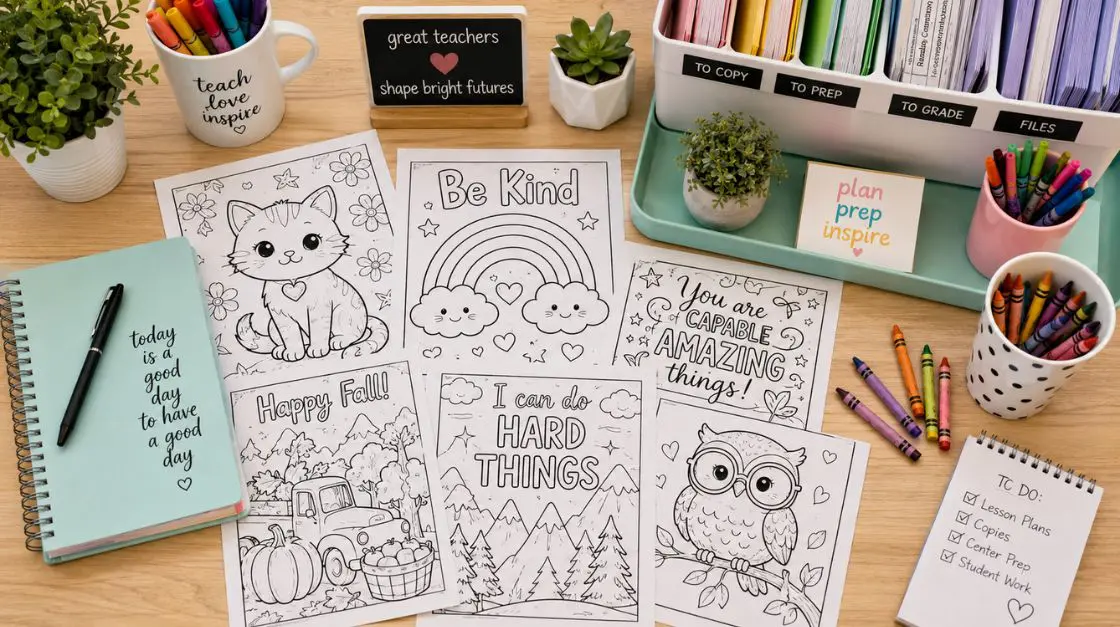
Here’s what intentional use of coloring pages actually looks like in real K–2 classrooms:
The Morning Work Station: A tray with 3–4 choices of coloring pages — one themed to the current science unit, one seasonal, one open. Students choose and work independently as the teacher takes attendance and handles arrival. No directions needed, no management needed.
The Literacy Center Rotation: Students rotate through five centers; one center is “illustration and labeling” — they color a picture and write the word for the main object. The page changes weekly to match the read-aloud book.
The Calm-Down Corner: Two chairs, a small table, a bin of colored pencils, and 5 simple coloring pages. Students who need to reset come here independently, color for a few minutes, and return without adult direction.
The Early Finisher Bin: A colorful box labeled “Done? Try this!” holds a rotating mix of coloring pages, including fantasy themes, cultural designs, and seasonal scenes. Students who finish early have a meaningful, engaging option that doesn’t require teacher attention.
The Friday Incentive: Students earn “free choice Friday” minutes by meeting the week’s classroom goals. Coloring page choice is one of the three options in the free choice box — and consistently the most popular.
Featured Classroom Resources from EG Creativity
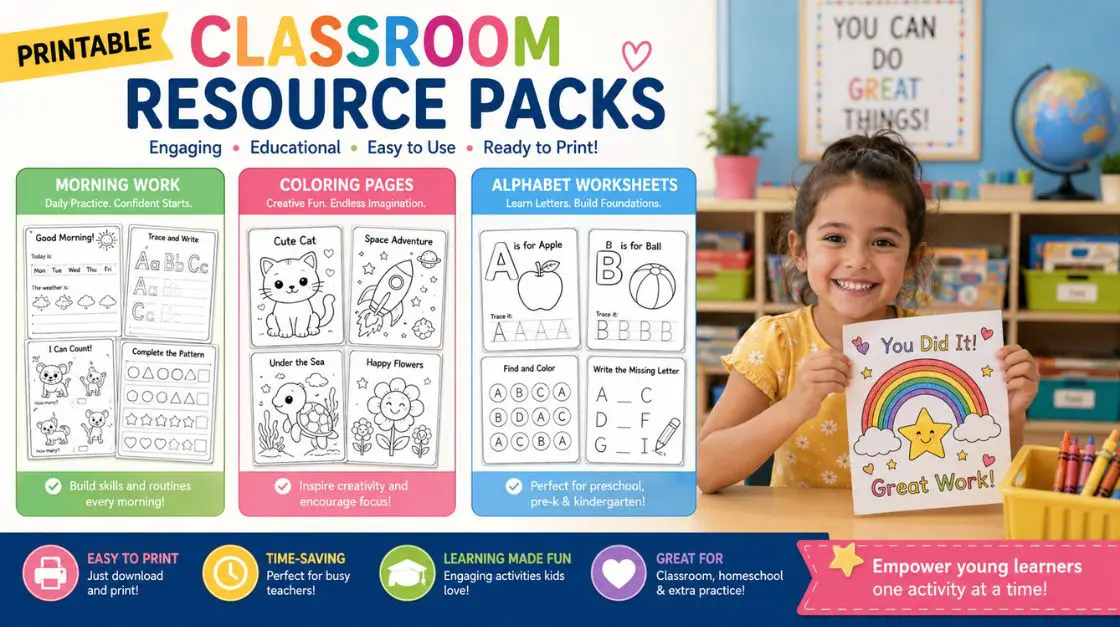
Morning Work Printables for K–2
Four weeks of no-prep daily pages designed specifically for K–2 morning routines. These classroom materials reduce transition chaos and help students start learning from the moment they walk in. Explore Morning Work Printables →
Summer Coloring Pages for Kids
A no-prep seasonal activity pack that works as classroom activities during the end-of-year period, summer school, or after-school programs. See Summer Coloring Pages for Kids →
Alphabet Tracing Worksheets
The complete A–Z set combines coloring and tracing for fine-motor and letter-recognition practice. One of the most-used classroom resources for kindergarten and first-grade teachers. Get the Full Alphabet Set →
World Cultures Coloring Pages for Kids
Screen-free learning that brings social studies to life. 35 pages covering world cultures — ideal for ESL teachers, multicultural education goals, and cultural awareness units. Explore World Cultures Pages →
Free Teacher Resources
Not ready to purchase? Start with the free library — classroom printables, coloring pages, and no-prep activities available instantly. Access Free Teacher Resources →
Frequently Asked Questions About Printable Coloring Pages for Classroom
Q1: Are printable coloring pages for classroom use appropriate for K–2 learners?
A: Yes. When used with a clear educational purpose, printable coloring pages for classroom learning are among the most developmentally appropriate classroom activities for K–2 students. They strengthen fine motor skills, improve attention, and reinforce learning across reading, math, science, and social studies. Choose pages that match your students’ developmental level and connect each activity to a learning objective.
Q2: How often should I use coloring pages classroom activities?
A: Many teachers include coloring pages classroom activities every day as morning work, brain breaks, or early-finisher tasks. Others use them weekly in literacy centers or subject rotations. The ideal frequency depends on your teaching style and classroom needs, but they work best when they support a meaningful learning goal.
Q3: What are the best printable coloring pages for classroom use with students who have special needs?
A: For students receiving occupational therapy or additional learning support, choose printable coloring pages for classroom instruction with bold outlines, simple shapes, and minimal visual clutter. These pages reduce cognitive overload while supporting fine motor development. Because they’re printable, you can easily enlarge them to create a more comfortable workspace.
Q4: Can ESL or ELL students benefit from coloring pages classroom resources?
A: Absolutely. Coloring pages classroom activities help overcome language barriers because pictures provide visual context. Pair each page with key vocabulary, labels, or short sentences in English—and, when possible, the student’s home language—to build vocabulary and confidence naturally.
Q5: How can I connect printable coloring pages for classroom lessons to curriculum standards?
A: Select printable coloring pages for classroom instruction that match your current unit, then extend the activity by asking students to label vocabulary, write a sentence, answer comprehension questions, or compare the illustration with real-world examples. These simple additions transform coloring into meaningful learning.
Q6: Are printable coloring pages for classroom use better than coloring books?
A: For most classroom activities, printable pages offer greater flexibility. Teachers can print exactly the number of copies they need, select pages that match current lessons, and reprint favorite resources whenever necessary, making them both practical and cost-effective.
Q7: Can substitute teachers use coloring pages classroom resources effectively?
A: Yes. Coloring pages classroom activities are ideal for substitute teachers because they require minimal preparation, keep students engaged, and work well with mixed ability levels. Keeping a folder of themed printable pages ready for substitutes helps maintain a productive classroom environment.
Q8: What types of printable coloring pages for classroom use work best for emotional regulation?
A: Simple designs featuring nature, animals, mandalas, or calming patterns are excellent printable coloring pages for classroom wellness activities. These pages encourage mindfulness and help students relax without becoming frustrated by overly detailed illustrations.
Q9: What’s the best way to organize printable coloring pages for classroom resources?
A: Organize your printable coloring pages for classroom collection by subject, season, grade level, or theme using binders or labeled folders. Keep a small selection of frequently used classroom activities readily available for early finishers, transitions, and calm-down corners.
Q10: Where can I find free printable coloring pages for classroom activities?
A: Many educational websites offer free printable coloring pages for classroom use, including themed worksheets, seasonal collections, and subject-based classroom activities. Starting with free resources allows teachers to build a versatile classroom library before investing in larger printable collections.
Useful Materials
Expand your classroom resource collection with these related guides and printables:
- Printable Teacher Resources for K–2 Classrooms — Less prep, more teaching
- Kindergarten Coloring Pages — Simple, age-appropriate designs for early learners
- World Cultures Coloring Pages for Kids — Screen-free multicultural learning
- Morning Work Printables for K–2 — Four weeks of daily pages
- Seasonal Coloring Pages — Year-round classroom activities
- Emotions Coloring Pages Printable — SEL and mindfulness support
- Coloring Pages for Kids — Benefits, activities, and free prints
- Cultural Competence Coloring Pages — World cultures guide for kids
- How to Print Coloring Pages at Home — Print setup guide for classrooms and home

Printable Activities for Kindergarten — Seasonal Bundle | No-Prep
Make Coloring Pages the Hardest-Working Tool in Your Classroom
The best classroom resources don’t demand more from you — they give more back. Coloring pages check every box: zero prep, universal accessibility, curriculum flexibility, and genuine student engagement. Whether you’re a kindergarten teacher building fine motor skills, a school counselor setting up a calm-down station, a substitute teacher managing transitions, or a homeschool parent looking for no-screen learning that your child will actually want to do, printable coloring pages belong in your toolkit.
Start with the free resources. Try one page tomorrow. Watch what happens.
Browse all printable classroom resources →