
Mindfulness Coloring & Journaling: Powerful Stress Relief
Why Journaling Belongs in Your Stress Relief Toolkit
Modern life moves fast. Between demanding schedules, digital overwhelm, and the pressure to always perform, stress has become something of a universal experience. The good news? You don’t need an expensive retreat or a therapist’s couch to start feeling better. Some of the most powerful techniques of stress management are already within your reach — a blank page, a pen, and a willingness to show up for yourself.
Creative journaling sits at the intersection of self-expression, mindfulness, and emotional processing. It’s not about writing perfectly or telling a linear story. It’s about using the act of putting words — and sometimes colors, doodles, or collages — onto paper as a way to release tension, gain clarity, and anchor yourself in the present moment. Whether you’re a seasoned journaler or you’ve never picked up a notebook outside of school, this guide will walk you through everything you need to know to use creative journaling as one of your core stress relief activities.
What Is Creative Journaling?
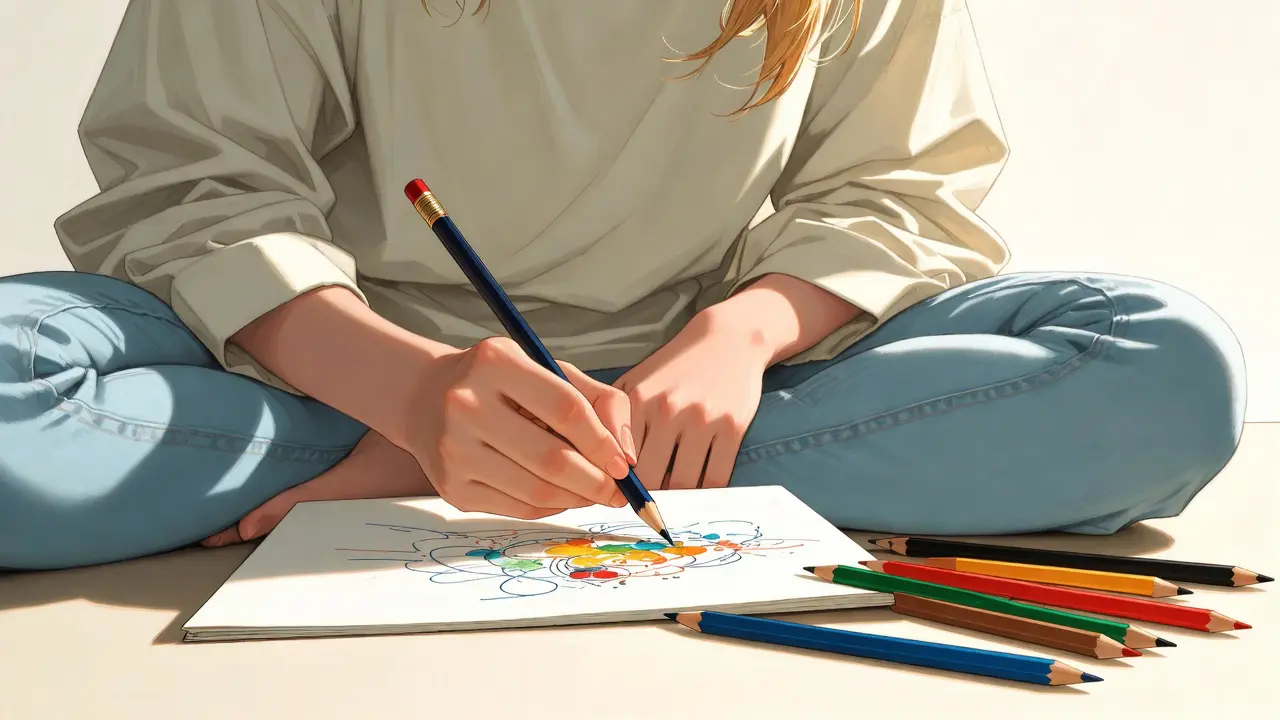
Creative journaling is an expressive practice that blends traditional diary writing with art, reflection prompts, gratitude lists, stream-of-consciousness writing, and visual elements. Unlike structured journals that follow a rigid format, creative journaling invites you to make the practice your own.
You might spend five minutes writing a stream-of-consciousness brain dump after a hard day. You might sketch a doodle next to a worry that’s been looping through your mind. You might fill in a mindfulness coloring page and then journal about how you feel afterward. The format is secondary — the intention is what matters: to slow down, tune in, and process what’s happening inside you.
Research consistently supports expressive writing as one of the more effective stress reducing activities. Studies have shown that writing about stressful events can lower cortisol levels, reduce anxiety symptoms, improve immune function, and even enhance mood over time. Creative journaling takes this science-backed foundation and adds layers of creativity and personal expression that make the practice more engaging, more sustainable, and more deeply nourishing.
The Science Behind Journaling and Stress Management
Before diving into practical techniques, it’s worth understanding why journaling works as one of the go-to techniques of stress management.
When you’re stressed, your nervous system activates its fight-or-flight response. Your prefrontal cortex — the rational, planning part of your brain — essentially goes offline while your amygdala sounds the alarm. Writing engages the prefrontal cortex, helping it come back online. The act of translating raw emotion into language is called affect labeling, and neuroscientists have found it measurably reduces the intensity of emotional distress.
Creative journaling amplifies this effect by incorporating additional sensory inputs. Choosing colors, arranging images, or drawing shapes alongside your words activates different neural pathways and deepens the grounding effect. This is also why mindfulness coloring has gained so much traction in recent years — it’s not just a trend, it’s a neurologically sound way to calm an overactive stress response.
Art Therapy Journal — “Can Coloring Mandalas Reduce Anxiety? A Replication Study” (van der Vennet & Serice, 2012) This experimental study found that coloring a mandala reduces anxiety to a significantly greater degree than coloring a plaid design or blank paper, with implications for art therapy practice. ERIC 🔗 https://eric.ed.gov/?id=EJ988118
Core Techniques: How to Use Creative Journaling for Stress Relief
1. Stream-of-Consciousness Writing (The Brain Dump)
Also known as “morning pages” (popularized by Julia Cameron in The Artist’s Way), this technique involves writing continuously for a set period — usually 10 to 20 minutes — without editing, censoring, or stopping. Whatever is in your head goes onto the page.
This is one of the simplest and most powerful stress relief activities you can adopt. It clears mental clutter, surfaces unconscious worries, and creates a sense of emotional spaciousness. You don’t need to read what you wrote. The act of writing is enough.
How to start: Set a timer for 10 minutes. Write “I feel…” and keep going until the timer ends. Don’t lift your pen. Don’t cross anything out.
2. Gratitude and Affirmation Journaling
Chronic stress often narrows our attention, causing what psychologists call a negativity bias — we notice what’s going wrong far more readily than what’s going right. Gratitude journaling deliberately retrains this bias.
Each day, write down three to five things you’re grateful for, no matter how small. Pair this with positive affirmations — short, present-tense statements that reinforce the mindset you want to cultivate. For example: “I am capable of handling what comes my way.” Or: “I choose peace over panic.”
If you want a structured container for this practice, the 60-Day Mood Journal – Daily Calm, Clarity and Affirmations is a beautifully designed tool that guides you through daily mood tracking, reflection prompts, and affirmations over two full months. Consistent daily use is where the real transformation happens — and having a dedicated journal makes the ritual feel intentional.
3. Emotion Mapping
Rather than writing in prose, emotion mapping involves drawing a rough outline of a body and marking where you feel emotions physically. Stress lives in the body — tight shoulders, a clenched jaw, a knotted stomach. Bringing conscious awareness to these sensations is a core part of somatic healing.
After drawing your emotion map, write a few lines about each area: What is this sensation trying to tell me? What does it need right now?
This is one of the more introspective stress reducing activities, bridging the gap between mental journaling and body-based awareness practices like yoga or breathwork.
4. Visual Journaling and Mindfulness Coloring
Not everyone is drawn to words. For visual thinkers, the creative journal might be more image-based — incorporating magazine cutouts, watercolor washes, hand-drawn mandalas, or dedicated mindfulness coloring pages.
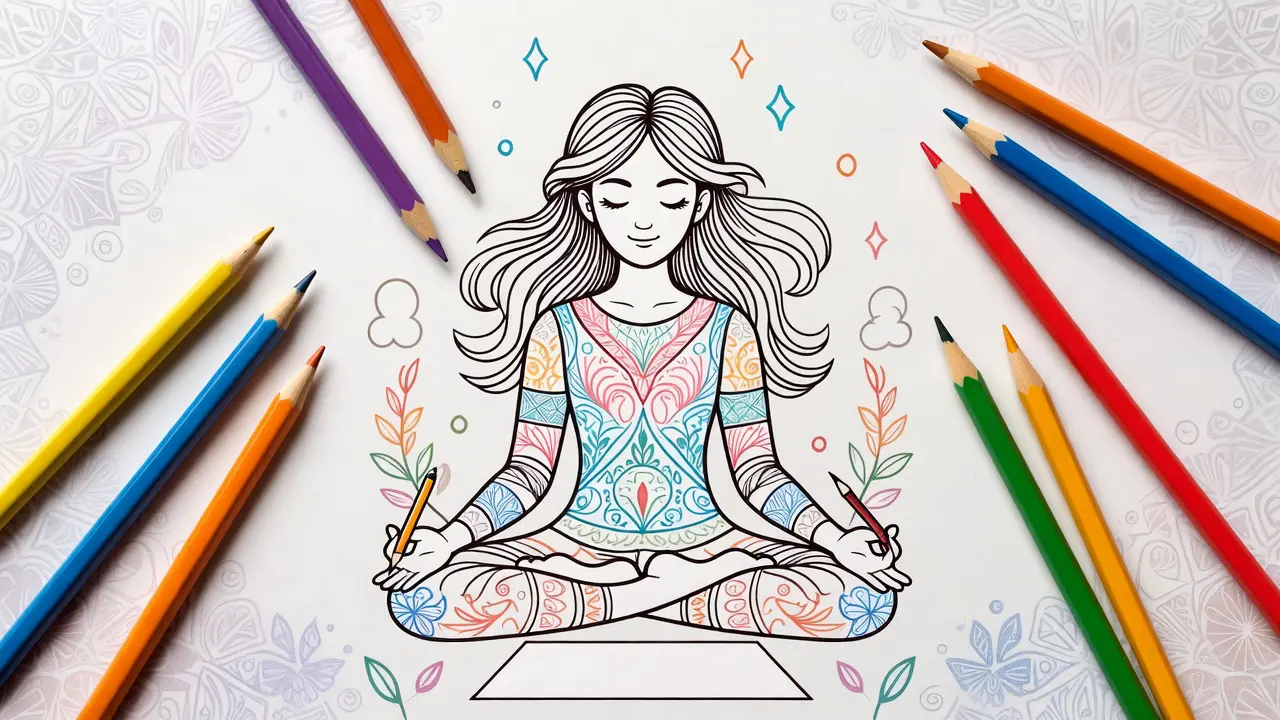
Mindfulness coloring has been widely adopted as one of the easiest stress relief activities to introduce into a daily routine. The repetitive, rhythmic nature of coloring — choosing hues, filling in shapes, staying within (or breaking out of) lines — activates a state of flow. Your analytical mind quiets. Your breath deepens. You arrive, fully, in the present moment.
Incorporating coloring directly into your journaling practice creates a natural transition: color first to settle your nervous system, then write to process what surfaces. You can explore dedicated Stress Relief Coloring Pages designed specifically with this intention — featuring intricate patterns, botanical illustrations, and calming mandalas that make it easy to drop into a meditative state before you begin writing.
5. Dialogue Journaling
This is a technique borrowed from Gestalt therapy and narrative therapy. You write a question — directed at a feeling, a situation, or even a version of yourself — and then write the answer as if the other party is responding.
For example:
Me: “Why am I so anxious about this project?” Anxiety: “Because you’re afraid you’re not good enough, and this feels like proof.” Me: “What do you need from me right now?” Anxiety: “To be heard, not pushed away.”
This kind of inner dialogue is startlingly effective. It externalizes the internal experience, making it easier to examine and respond to rather than simply react from. As a component of broader techniques of stress management, dialogue journaling builds emotional intelligence and self-compassion simultaneously.
6. The “Letter to Self” Practice
Write a letter to your past self, your future self, or the version of yourself currently in the thick of stress. This creates psychological distance — a key mechanism in emotion regulation — that allows you to access compassion and perspective you might struggle to find when you’re in the eye of the storm.
A letter to your past self acknowledges how far you’ve come. A letter to your future self plants seeds of intention and hope. A letter to your current self offers the kindness you might freely give a friend but rarely extend to yourself.
Recommended for This Topic

SAGE Journals — “Journaling: A More Mindful Approach to Researching a Mindfulness-Based Intervention” (Crawford et al., 2021) This qualitative study found that children using mindfulness diaries with coloring sheets reported calming and relaxing effects — the combination of journaling, doodling, and coloring supported present-moment awareness. Sage Journals 🔗 https://journals.sagepub.com/doi/10.1177/16094069211014771
Building a Sustainable Journaling Habit
The most beautifully designed journal in the world is useless if it stays on the shelf. Sustainability is everything. Here’s how to make creative journaling one of your reliable stress reducing activities for the long term:
Anchor it to an existing habit. Don’t try to carve out a brand-new time slot from scratch. Instead, attach journaling to something you already do: morning coffee, the commute, winding down before bed.
Start small. Five minutes a day will do more than an hour once a week. Consistency creates the neural pathways that make reflection feel natural and automatic.
Remove friction. Keep your journal and a good pen somewhere visible and accessible. If you’re using coloring pages as part of your practice, have them printed and ready alongside your colored pencils or markers.
Release perfectionism. Creative journaling is not a performance. No one is grading your handwriting, your insights, or the quality of your drawings. The mess is part of the medicine.
Track your mood. One of the most motivating things you can do is notice how you feel before and after journaling. Over time, this data — even if it’s just a number from 1 to 10 — builds a compelling case that the practice actually works. A structured tool like the 60-Day Mood Journal – Daily Calm, Clarity and Affirmations makes this tracking effortless and cumulative, giving you a two-month arc of emotional data to reflect on.
Combining Creative Journaling with Other Stress Relief Activities
Creative journaling works beautifully as a standalone practice, but it also integrates seamlessly with other stress relief activities:
Yoga or stretching + journaling: Move first, then write. Physical movement releases stored tension and opens the body up for emotional processing on the page.
Meditation + journaling: Meditate for 5–10 minutes, then immediately journal whatever arose. The reflective writing anchors insights that might otherwise dissolve.
Mindfulness coloring + journaling: As described above, coloring quiets the mind before you write. Start with Stress Relief Coloring Pages to ease into the session, then let the writing flow from there.
Nature walks + journaling: Walk without your phone, notice the world around you, and then journal about what you observed and felt when you return. This combination is quietly one of the most effective stress reducing activities known.
🎨 Not sure where to start?
Here are our most loved products.
FAQ: Creative Journaling for Stress Relief
🎨 Not sure where to start? Here are our most loved products.
Q1: Do I need to be a good writer to start creative journaling? A: Absolutely not. Creative journaling is not about literary quality — it’s about honest expression. You don’t need grammar, structure, or eloquence. You just need a willingness to show up and write whatever is true for you in this moment. The “skill” that matters is self-honesty, not writing ability.
Q2: How is creative journaling different from regular diary writing? A: A traditional diary tends to record events chronologically — what happened today. Creative journaling is more inward-facing. It’s concerned with how you feel about what happened, what patterns you’re noticing, what you want to release or cultivate. It also incorporates creative elements — coloring, drawing, collage, prompts — that a standard diary typically doesn’t.
Q3: How often should I journal to see stress relief benefits? A: Daily journaling, even for just five to ten minutes, tends to yield the most consistent benefits. That said, any regular practice is better than none. If daily feels overwhelming, aim for three to four sessions per week and build from there. Tracking your mood alongside your journaling — as in the 60-Day Mood Journal — helps you see your own patterns and progress.
Q4: Can mindfulness coloring really help with stress? A: Yes, and there’s good evidence to support it. Mindfulness coloring activates a relaxation response similar to meditation, engaging the parasympathetic nervous system and reducing cortisol. It also promotes a state of flow — absorbed, effortless focus — that interrupts the rumination cycle that fuels chronic stress. Used regularly alongside journaling, it becomes one of the more enjoyable stress relief activities in your toolkit.
Q5: What should I write about when I don’t know where to start? A: Try one of these prompts: “Right now, my body feels…” / “The thing I keep thinking about but haven’t said out loud is…” / “If I could give myself one piece of advice today, it would be…” / “I am grateful for…” Even a single sentence is enough to open the door. The pen often finds its own direction once you take the first step.
Q6: Is journaling one of the recommended techniques of stress management by mental health professionals? A: Yes. Expressive writing and reflective journaling are widely recommended by therapists, counselors, and wellness practitioners as part of a holistic approach to mental health. They are especially noted for their accessibility — no special equipment, no appointment needed, no cost. Combined with other stress reducing activities like exercise, social connection, and adequate sleep, journaling forms a powerful layer of emotional self-care.
Conclusion: The Page Is Always There for You
Stress will always be part of life. But so will your capacity to process it, release it, and return to equilibrium. Creative journaling — in all its imperfect, messy, beautiful forms — is one of the most accessible and sustainable techniques of stress management available to you.
Whether you begin with five minutes of free writing each morning, fill in a Stress Relief Coloring Pages spread as a meditative warm-up, or commit to a structured two-month journey through a 60-Day Mood Journal, the path to a calmer, clearer mind begins with a single page.
You don’t have to figure everything out at once. You just have to start.
Combining journaling with coloring has deepened both practices. The creative-reflective combo is brilliant.
Art therapy doesn’t have to be formal therapy. This accessible approach brings healing benefits to daily life.
My neighbor mentioned these and I was initially skeptical, but after trying a few I completely understand the appeal. Very well done.