
How to Write a Thank You Card: The Complete Guide to Printing, Folding, and Sending the Perfect Note
There’s something quietly powerful about a handwritten thank you card. In a world of instant messages and email replies, taking time to sit down and write a heartfelt note tells someone: you mattered enough for me to slow down. Whether you’ve just received a wedding gift, a teacher went above and beyond, or a client trusted you with their business, knowing how to write a thank you card well is one of the most underrated social skills you can have.
This guide covers everything: what to write in a thank you card, how to print a thank you card at home, how to fold it correctly, and which occasions call for which style. If you’ve ever wondered how to write a thank you card that actually resonates — not just a polite obligation, but a note someone treasures — you’re in exactly the right place. By the end, you’ll have a complete system that makes the whole process feel effortless — and genuinely meaningful.
➡️ Ready to skip straight to printing? Browse our printable thank you cards collection for beautiful designs you can download and print today.
Quick Answer
How to Write a Thank You Card
To write a thank you card effectively, follow this simple structure: open with a warm greeting, name the specific gift or gesture, explain how it made you feel or how you’ll use it, mention the person or occasion, and close with a sincere sign-off. Keep it between 3–6 sentences. Personal and specific always beats generic and long. For printing, download a PDF, load cardstock in your printer, and print at 100% scale with high-quality settings. Want to know how to print a thank you card perfectly every time? Step 2 of the guide below covers every detail.
Why Writing a Thank You Card Still Matters
It Creates a Lasting Emotional Impression
Studies in positive psychology consistently show that expressing gratitude benefits both the giver and the receiver. When you write a thank you card and send it to someone, you don’t just acknowledge a gift — you deepen the relationship. Neuroscience research suggests that receiving a handwritten note activates the brain’s reward centers in a way that digital messages simply don’t replicate.
For the person writing, the act of slowing down, choosing words carefully, and putting pen to paper is also a form of mindfulness. It’s a few minutes of focused, intentional reflection in an otherwise frantic day.
Real-Life Use Cases Where Thank You Cards Make a Difference
- Weddings and bridal showers — Guests remember whether they received a card. It’s expected, and when it arrives weeks after the event with a specific personal touch, it genuinely moves people.
- Job interviews — A brief thank you note sent within 24 hours sets candidates apart. It’s rare enough to be memorable.
- Teacher appreciation — A handwritten card from a student or parent lands differently than an email. Teachers keep these for years.
- Business relationships — Small business owners and freelancers who send thank you cards after a first project report stronger client retention.
- Everyday kindness — A neighbor helped you move furniture. A friend drove you to the airport. A thank you card acknowledges that you noticed.

The Psychology Behind a Handwritten Note
Why Physical Cards Feel More Meaningful Than Digital Ones
Research published in the Journal of Experimental Social Psychology found that people significantly underestimate how much their gratitude notes mean to recipients. We tend to assume our words feel awkward or obvious — but recipients experience them as warm, thoughtful, and surprising.
There’s also the tactile element. Holding a physical card activates a different kind of processing than reading a screen. The paper, the handwriting, the stamp on the envelope — all of it creates what researchers call a “memory trace” that digital correspondence simply can’t replicate.
What Teachers, Therapists, and Etiquette Experts Say
Etiquette experts widely agree that the most important rule in how to write a thank you card is specificity. Vague gratitude (“Thanks so much for everything!”) lands with a thud. Specific gratitude (“Your speech at the rehearsal dinner made everyone in the room laugh and cry at the same time — I’ll never forget it”) lands like a gift.
Therapists working in positive psychology often assign thank you letter exercises as a clinical intervention. The research is clear: articulating specific appreciation for another person elevates mood, reduces rumination, and strengthens social bonds.
For educators: Students who learn how to write a thank you card develop stronger communication skills and emotional intelligence. Knowing what to write in a thank you card — and practicing it regularly — is a real-world writing exercise that builds vocabulary, empathy, and social awareness simultaneously.
Types of Thank You Cards: Which One Do You Need?
Not all thank you cards are created equal. The right tone and format depend on the occasion, your relationship with the recipient, and the delivery method. Here’s how to match the card to the moment.
Wedding Thank You Cards
Best for: Brides, grooms, newlyweds, and wedding party members. Tone: Warm, personal, formal, or semi-formal. Key rule: Sent within three months of the wedding — the sooner, the better
Wedding thank you cards are among the most important social obligations in the event world. When you’re figuring out how to write a thank you card for a wedding, each one should mention the specific gift, how you plan to use it, and a personal detail connecting the sender to your memory of the day. If you need inspiration for what to write in a thank you card for wedding gifts, the templates section below has you covered.
If you’re planning ahead, our printable thank you cards include elegant, wedding-ready designs you can customize and print at home — or take to a local print shop.
Business and Professional Thank You Cards
Best for: Job seekers, freelancers, small business owners, and office managers. Tone: Professional, concise, genuine. Key rule: Send within 24–48 hours of the interaction
After an interview or a completed project, a handwritten or printed note reinforces your professionalism and leaves a lasting impression. Many professionals find that once they learn how to write a thank you card for business settings — concise, specific, sincere — they send them far more frequently. Keep these shorter — 3–4 sentences — and match the formality to your industry.
Teacher and Student Thank You Cards
Best for: Students, parents, homeschool families, school administrators Tone: Warm, sincere, age-appropriate Key rule: Be specific about what the teacher did that mattered
A parent writing on behalf of a young child can help them dictate what they want to say. Older students benefit from writing these themselves — it’s an exercise in gratitude and communication. If you’re wondering what to write in a thank you card for a teacher, keep it short, sincere, and specific about one thing the teacher did that really stood out. Our free printable thank you cards include designs suitable for classroom use.
Everyday and Gift-Giving Thank You Cards
Best for: Birthday gifts, holiday presents, acts of kindness, favors. Tone: Casual to semi-formal depending on the relationship. Key rule: Don’t wait too long — a thank you card sent weeks late feels obligatory, not genuine
For everyday use, a simpler card with a brief, warm note works perfectly. These are often the most charming — a short, honest line from a friend means more than a lengthy formal letter.
Sympathy and Bereavement Thank You Cards
Best for: After a funeral, a memorial, or during grief. Tone: Quiet, gentle, sincere. Key rule: Short is perfect — grief doesn’t require lengthy words
These cards acknowledge the kindness shown during an incredibly hard time. They don’t need to be elaborate. A single genuine sentence is enough.
Printable vs. Store-Bought Thank You Cards: Which Is Better?
Before diving into how to print a thank you card and how to write a thank you card message, it helps to understand whether printable or store-bought cards better fit your needs. Here’s a complete comparison:
| Feature | Printable Thank You Cards | Store-Bought Cards |
|---|---|---|
| Cost | Low — often $2–$8 for a full set | $3–$8 per card |
| Convenience | Instant download, print at home | Requires a trip to the store |
| Customization | High — write your own message | Limited to printed text |
| Design variety | Extensive — hundreds of styles | Limited to shelf stock |
| Print quality | Excellent with a good printer | Professionally printed |
| Environmental impact | Print only what you need | Packaging waste, shipping |
| Accessibility | Available 24/7 from anywhere | Store hours apply |
| Bulk options | Yes — print as many as needed | Usually sold in small packs |
| Lead time | None — immediate | Same day if in stock |
For most people — especially busy parents, teachers, wedding planners, and small business owners — printable thank you cards are the clear winner for flexibility and value. Once you download a file like our thank you card printable set, you can print it once or dozens of times for different occasions.
How to Write a Thank You Card: Step-by-Step
Whether you’re sending your first note or your fiftieth, this step-by-step breakdown shows you exactly how to write a thank you card from start to finish — from choosing your design to sealing the envelope.
Step 1: Choose the Right Card for the Occasion
Before you put pen to paper, choose a card that matches the tone of the moment. A minimalist white card suits a professional setting. A floral watercolor design works beautifully for a wedding or baby shower. A fun, colorful design fits a child’s birthday or teacher gift. Knowing how to print a thank you card starts with choosing the right design — the format and finish of the card shape everything that follows.
If you’re printing at home, browse designs by occasion — our full printable cards collection organizes everything by event type.
Step 2: Know How to Print a Thank You Card Correctly
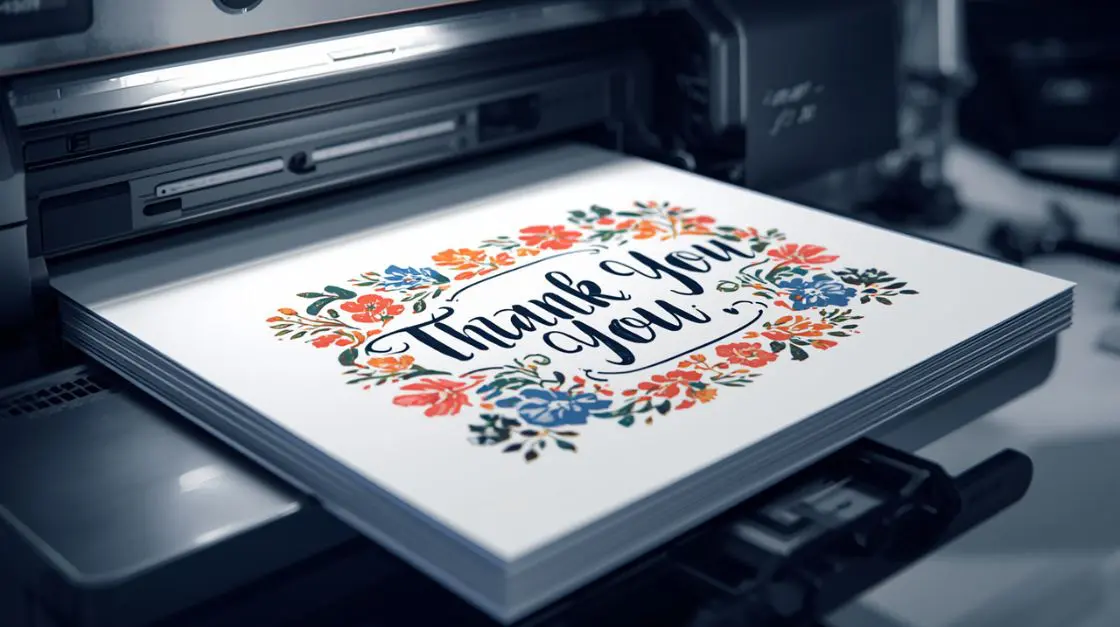
Learning how to print a thank you card at home is easier than most people think, and it unlocks massive flexibility — you can print exactly what you need, when you need it. Here’s what you need:
- A printer (inkjet or laser, both work)
- Cardstock paper — at least 80 lb/216 gsm for best results
- Your downloaded PDF file
Print settings to use:
- Select “Actual size” or “100%” — never “fit to page,” which resizes the design
- Choose “Best” or “High quality” print mode
- For A4 or US Letter designs, confirm your paper size matches before printing
For the best results with home printing, our post on the best paper for printing coloring pages also applies directly to cards — the paper quality tips are identical.
If you’re printing in large quantities and want to print a thank-you card at a more professional level, consider taking your PDF file to a local print shop or an online print service for a more polished finish. Many print shops accept digital PDF files directly.
Step 3: How to Fold a Thank You Card Properly
Most printable thank you cards are designed as 5×7-inch foldable cards. Here’s how to fold them perfectly:
- Print on cardstock — thinner paper won’t hold a crisp fold
- Score the fold line first — use a bone folder or the back of a butter knife along a ruler to create a clean crease line before folding
- Fold away from the print — the outside of the card should face outward when you fold
- Press firmly and evenly — run your thumb or a bone folder along the fold to set it flat
- Let it rest — place the folded card under a heavy book for 5–10 minutes to flatten the crease
A well-folded card immediately looks professional, even when printed at home.
Step 4: Understand What to Write in a Thank You Card
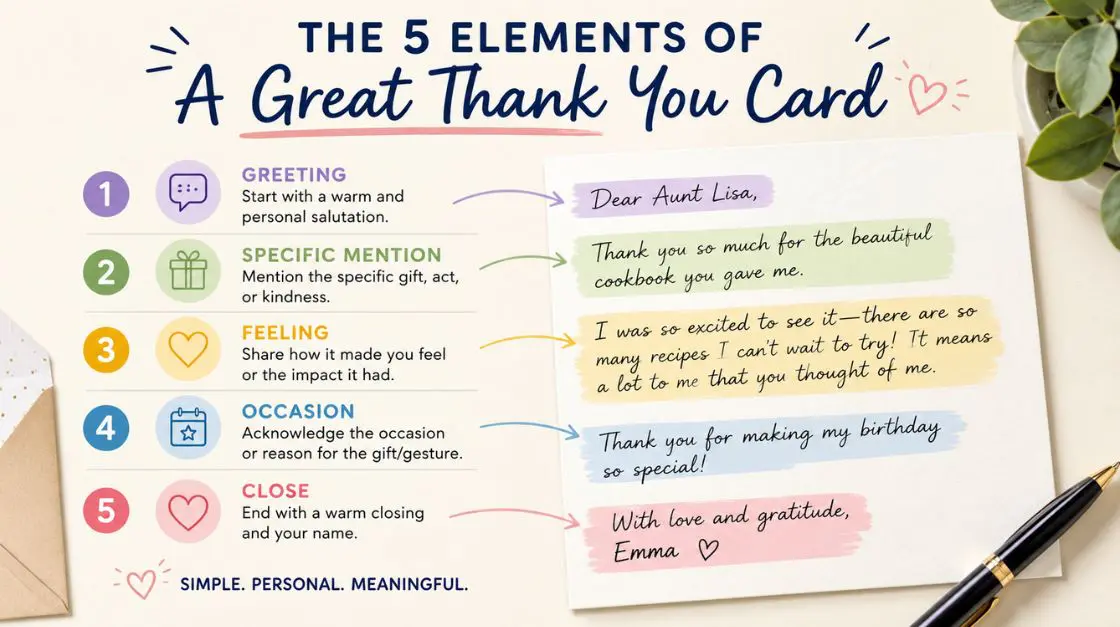
This is where most people freeze. The blank interior of a card can feel intimidating — especially when you’ve been wondering how to write a thank you card that doesn’t sound stiff or generic. Here’s a simple, proven formula for what to write in a thank you card, no matter the occasion:
The 5-Part Formula:
- Open with a greeting — use the person’s name (“Dear Sarah,” or “Hi Marcus,”)
- Name the gift or gesture specifically — “Thank you so much for the gorgeous set of kitchen knives”
- Explain the impact — “We’ve already used them twice this week and they’re incredible”
- Make a personal connection — “It means so much coming from someone whose cooking I’ve always admired”
- Close warmly — “With love and gratitude,” or “Warmly,” followed by your name
Example of what to write in a thank you card (wedding gift):
Dear Aunt Helen, Thank you so much for the beautiful linen tablecloth — it’s already on our dining table and it looks stunning. Your taste is always impeccable, and we think of you every time we sit down to dinner. We can’t wait to have you over to see it in person. With love, Maya and Tom
Example of what to write in a thank you card (job interview):
Dear Mr. Johnson, Thank you for taking the time to meet with me this morning. Our conversation about the company’s expansion into new markets left me even more excited about this opportunity. I hope to have the chance to contribute to that work. Best regards, Amira Patel
Step 5: Choose the Right Pen and Writing Style
Ballpoint pens work for most cards. For something more polished, a medium-tip felt pen or fineliner gives cleaner lines. Avoid using pencil (it smudges) or ultra-fine pens that can bleed on cardstock.
Write slowly and deliberately. Neat handwriting matters more than artistic handwriting. If your natural handwriting is difficult to read, print your letters rather than using cursive.
Step 6: Address and Send the Envelope
For formal occasions, hand-address the envelope rather than printing a label. Write the recipient’s full name and address clearly, and add your return address on the back flap or top-left corner of the front.
Need an envelope that fits your 5×7 card? Our printable A4 envelope template for 5×7 cards lets you print a matching envelope at home.
Seal the envelope with water (or a sponge — never your tongue on large batches), add a stamp, and mail it the same day if possible.

What to Write in a Thank You Card: Templates for Every Occasion
Knowing how to write a thank you card is one thing — but having reliable templates removes blank-page paralysis entirely. Below you’ll find word-for-word examples of what to write in a thank you card for the most common situations. Customize these to suit your voice.
Thank You Card Wording for a Wedding Gift
Dear [Name], Thank you so much for the [specific gift]. We’ve already [used it / displayed it / started enjoying it] and it’s become one of our favorites. Your presence on our wedding day meant the world to us, and this gift is a beautiful reminder of your love and generosity. With warmth and gratitude, [Your names]
Thank You Card Wording for a Birthday Gift
Dear [Name], Thank you for the wonderful [gift] — you always know exactly what I’d love! It made my birthday feel so special. I’m so lucky to have you in my life. With love, [Your name]
Thank You Card Wording for a Teacher
Dear [Teacher’s name], Thank you for everything you’ve done for [child’s name] this year. Your patience, creativity, and care have made such a difference. [He/She/They] talks about your class all the time, and we’re so grateful to have had you as a teacher. With sincere appreciation, [Parent’s name] and [Child’s name]
Thank You Card Wording for a Business Gift or Gesture
Dear [Name], Thank you so much for [the gift / your support / your referral]. It’s a genuine pleasure working with someone of your caliber, and your thoughtfulness means more than you know. I look forward to continuing our work together. Warm regards, [Your name]
Thank You Card Wording After a Sympathy Gesture
Dear [Name], Thank you for your kindness during such a difficult time. Your [flowers / meal / presence / note] was a real comfort, and we’re deeply grateful for your support. With heartfelt thanks, [Your name]
Visual Inspiration: Styles and Designs to Consider
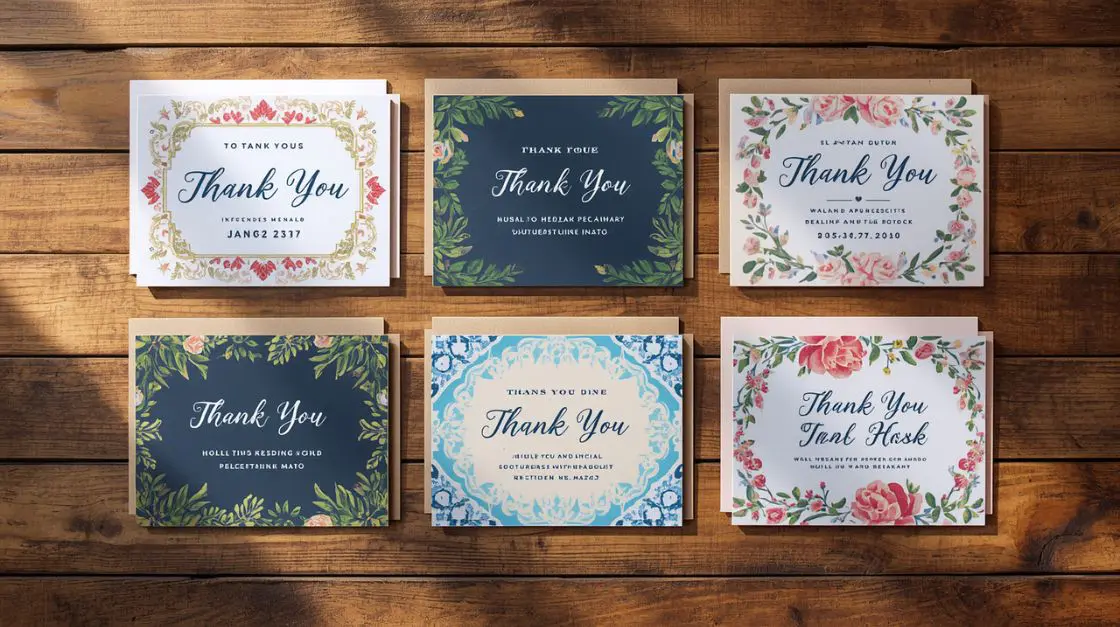
When choosing a printable thank you card design, consider the overall aesthetic and your personal style. The right design also helps set the tone for what to write in a thank you card — a formal card invites more structured language, while a playful design gives you permission to be warm and casual. Here are a few popular design directions:
Watercolor Floral: Soft washes of botanical color — roses, peonies, eucalyptus sprays. These feel romantic and elegant, perfect for weddings, bridal showers, and heartfelt personal notes. Pair with cream or blush envelopes.
Minimalist Modern: Clean white or ivory backgrounds with simple typography. These work for professional settings, business thank you cards, or anyone who prefers understated elegance. Black ink on white cardstock prints sharply at home.
Boho and Earthy: Warm terracotta, sage green, and ochre tones with hand-lettered text. Perfect for casual gifting, market vendors, small business owners, and creative professionals.
Classic and Traditional: Navy or forest green backgrounds with gold foil-effect text. These feel formal and timeless — ideal for wedding thank yous, memorial notes, and corporate gifting.
Fun and Playful: Bright colors, bold patterns, illustrated characters. Great for children’s birthdays, school events, and anyone who wants the card itself to feel like a gift.
Browse design collections on EG Creativity’s printable cards shop to see all available styles.
Featured Products: Printable Thank You Cards Worth Downloading
Your Perfect Thank You Card Starts Right Now
Knowing how to write a thank you card — truly write one, with specific warmth and genuine intention — is a skill that opens doors, deepens relationships, and makes you someone people remember. Once you also know how to print a thank you card at home and what to write in a thank you card for every situation, the whole process becomes second nature. It takes five minutes and costs almost nothing. The return? Someone feeling genuinely seen and appreciated.
Whether you’re sending one card this week or a hundred before your wedding, the process should feel joyful, not stressful. Download a beautiful printable design, follow this guide on how to print a thank you card at home using good cardstock, score and fold with care, and write from the heart. If you ever forget how to write a thank you card that lands perfectly, bookmark this page — the formula and templates will always be here when you need them.
How to write a thank you card is a skill that gets easier and more natural every time you do it.
Every thank you card you send is a small act of connection in a world that needs more of them.
➡️ Start today: Download printable thank you cards — instant PDF, print at home, ready in minutes.